The First App Store
1982-1983
Greg Bryant

Honestly, because of the nature of the computer business,
with strange products demanded by people who are strangely
in positions of power, surrounded by secrecy, sometimes released
in secrecy -- nobody can know if this was the first app store.

I thought it was a pretty natural thing to do, working at a Berkeley
startup (Virtual Microsystems) that simulated personal computers on
mainframe timesharing systems.

I wrote this proposal late in 1982, and built it in 1983, combining
our phone-terminal board and software with our virtual CP/M and DOS
machine boards and software, running on our in-office Vax 11/780.

I talked about it repeatedly to individuals around the floor at the
'West Coast Computer Faire' in March of 1983, where I gave a paper
on a different topic, and coordinated the micro software section.
I chatted with Steve Jobs at this conference, but I have no idea
if I influenced him.

Significantly, 'The Virtual Store' wasn't just for buying software online.

It also allowed an online demo -- with a disposable virtual machine!
And we charged people for the privilege of using it.

That said, I was very disappointed at this startup's management,
by the time we released it. The store was shut down because I left,
and because the sales team didn't quite know how to grow the
customer base. Too far before its time, perhaps.

I did some consulting for a while, and then went to work
at Intel headquarters as a Unix 'guru' / evangelist,
attached to the 386 team.

In 1997, during the dotcom boom, I revisited this demo idea
at my Palo Alto startup, Workspot.
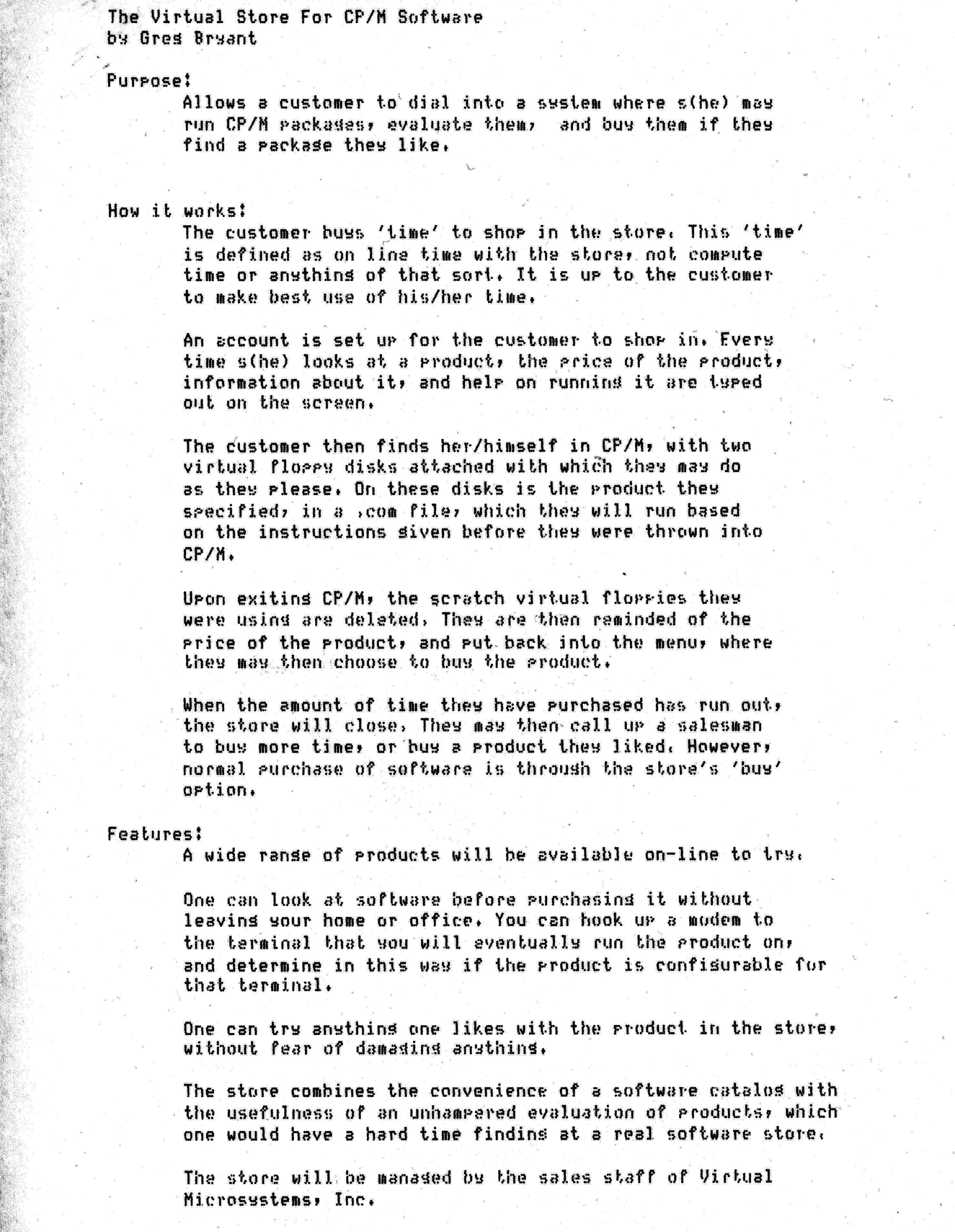
The Virtual Store For CP/M Software
by Greg Bryant

Purpose:

Allows a customer to dial into a system where s(he) may
run CP/M Packages, evaluate them and buy them if they
find a package they like.

How it works:

The customer buys 'time' to shop in the store. This 'time'
is defined as on line time with the store, not compute
time or anything of that sort. It is up to the customer
to make best use of his/her time.

An account is set up for the customer to shop in. Every
time s(he) looks at a product, the price of the product,
information about it, and help on running it are typed
out on the screen.

The customer then finds her/himself in CP/M, with two
virtual floppy disks attached with which they may do
as they please. On these disks is the product they
specified, in a .com file, which they will run based
on the instructions given before they were thrown into
CP/M.

Upon exiting CP/M, the scratch virtual floppies they
were using are deleted. They are then reminded of the
price of the product, and put back into the menu, where
they may then choose to buy the product.

When the amount of time they have purchased has run out,
the store will close. They may then call up a salesman
to buy more time, or buy a product they liked. However,
normal purchase of software is through the store's 'buy'
option.

Features:

A wide range of products will be available on-line to try.

One can look at software before purchasing it without
leaving your home or office. You can hook up a modem to
the terminal that you will eventually run the product on,
and determine in this way if the product is configurable for
that terminal.

One can try anything one likes with the product in the store,
without fear of damaging anything.

The store combines the convenience of a software catalog with
the usefulness of an unhampered evaluation of products, which
one would have a hard time finding at a real software store.

The store will be managed by the sales staff of Virtual
Microsystems, Inc.